
iLEAD Programme
Students are equipped with the skills and tools to transition to higher education, gain paid employment or start businesses, while contributing to community and national development.
We empower enablers such as teachers and recent graduates to aid sustainability and promote near-peer influence for the students. The programme is an experiential project-based training on leadership, life, employability and entrepreneurship skills; digital and technical skills; internships and change projects implementation.
Why address youth skills development and transitions in Nigeria?
According to NBS 2020 Q4 report, 73.2% of young people in Nigeria were unemployed or underemployed. There are limited employment opportunities; it has been postulated that about 40 to 50 million jobs would be needed to address unemployment (a large percentage of who are young people) between 2010 to 2030 in Nigeria.
The World Economic Forum Report 2017 identifies that for the growing youth population in Africa to spur the economic growth of the continent, a number of issues that must be resolved includes increasing access to education and skill training, expanding job possibilities, encouraging entrepreneurship, and tackling the digital gap that exists in many regions of the continent.
Programme Components
Students
Life and Leadership Skills
Self-leadership skills such as setting goals, developing a values system, personal financial management, creativity; and skills for leading others, and implementing community change projects.
Employability Skills
Entrepreneurship skills
Technical, Vocational and Digital skills
Transition Planning
Fellows
The fellowship year components include:
Education & Leadership Training
Fellows will be trained on pedagogy and classroom management, leadership, mentoring and facilitation skills.
Peer Monitoring
Fellows will be required to train other members of the National Youth Service Corps on the leadership, life, employability and entrepreneurship skills they develop during the fellowship.
Mentoring
Fellows will be paired with mentors – entrepreneurs or professionals – for six months in-line with their professional or business goals.
Technical and Digital skills
Employability & Entrepreneurship Training Fellows will go through trainings aimed at increasing their commercial awareness and helping them develop work-readiness skills, knowledge and tools needed to thrive on their jobs.
Internship
Fellows will be supported in varied ways that best suit their interests i.e. Internships (one-month internship in organisations in high growth sectors), professional development/technical skills training or business accelerator programmes.
Alumni Engagement & Support
Fellows who complete the programme will be inducted into LEAP Africa’s Alumni Network (LAAN) through which they will be provided access to opportunities and training.
Fellows’ Testimonials
Teachers
The programme components for teachers include:
Leadership and Classroom Management
Training for teachers on classroom management, transformative leadership and mentorship.
Community of Practice (CoP)
A school-based platform where all trained teachers are able to connect with one another, provide support and also access shared opportunities, and resources by the LEAP team.
Curriculum Delivery and Student Mentoring
Teachers will participate in the curriculum delivery sessions in collaboration with the iLEAD fellows.
Peer Mentoring
Trained teachers will be encouraged to serve as mentors to other teachers, sharing lessons from the leadership and education management training.
The programme components for teachers includes
Success Stories


Meet Emem, a 20 year old Employer
Read Emem's Story
Emem graduated from the iLEAD programme in 2020 and is yet to secure admission into higher institution. However, while in secondary school, he started a business of selling customised groundnuts and zobo, and he generated enough money to employ some of his colleagues.
While running his business, he had always been interested in computer programming, hence upon graduation from secondary school, his business had generated sufficient funds to purchase a laptop and data subscription that allowed him to download tutorial videos on programming.
In 2021, he observed that he could pay for services using his debit card online and spotted some gaps in logistics and payments online, hence picking an interest in building a financial application. After a couple of failures, he created the Etegram application. Etegram is a financial solution application that allows people and businesses to transact funds and can be used as a one-commerce website to collect payments.
In Emem’s words, he said, “When I started Etegram, everyone didn’t believe I could build a PayPal for Africa. After months of working on this solution, I convinced different commerce website owners to start receiving instant payments from their websites in seconds. Today, we are simplifying payments in Africa”.
At present, Emem has employed 6 of his colleagues from secondary school.
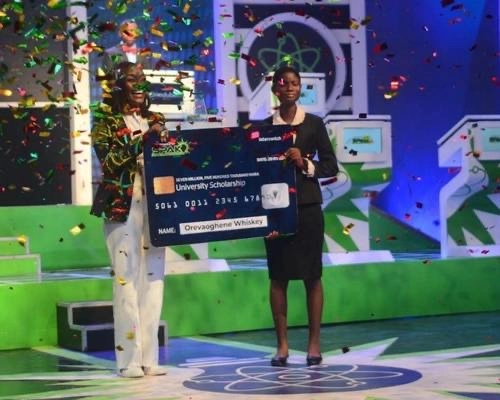
Whiskey Orevaoghene, Winner of InterswitchSPAK National Science Competition 4.0
Read Oreva's Story
Oreva is a student of Top Faith Schools, and she participated in the iLEAD programme in 2021/2022. Currently in SS3, she participated in the InterswitchSPAK National Science Competition, and she emerged winner of the competition which earned her a 5-year University Scholarship worth N7.5 Million with a brand-new laptop and monthly stipend.
Our Impact
iLEAD Programme in Pictures
We can't help everyone, but everyone can help someone
Our Partners